Our wilderness programs are informed by the guidelines and best practices of the Wilderness Medical Society (WMS), which outlines best practices for managing trauma, environmental emergencies, and medical issues in wilderness settings. We are so proud of our student Nicole for jumping in without hesitation during this real-world rescue, and we are grateful to her and to Tim for allowing us to share their story.
Three days into a section hike of the Pacific Crest Trail, Nicole Swanson was doing what most backpackers do on a warm afternoon: resting her feet, refilling water, and enjoying a lunch break by a creek. She had no idea that the Wilderness First Aid (WFA) certification she’d earned the previous October was about to get its first real-world test, and that she’d handle it with a level of composure most people never have to find out they have.
A Chance Meeting on Section K
Nicole and three friends were hiking California Section K of the PCT, from Echo Lake to Donner Summit. They’d stopped for lunch at a creek crossing when another group of three hikers — Tim Mosman and his two friends, one of whom was section-hiking the PCT, arrived at the same spot to rest and refill water.
The two groups struck up a conversation and Tim headed down to the creek to filter water. As he made his way back across the creek, carrying a four-liter water bladder in one hand and a cool rock he’d picked up in the other, he lost his balance.
“I thought, this is going to be embarrassing, but I’m just going to get wet, no big deal,” Tim recalled. Instead, he pitched forward and struck his head on a rock at the edge of the creek.

Tim Mosman in good spirits after the injury with cool rock in hand.
“That’s an SOS”
Tim was still lying where he’d fallen, now on his back in the shallow creek, blood running down his chest and into the water. He hadn’t lost consciousness.
Nicole ran to her pack, pulled out non-stick gauze pads and roller wrap, and handed them to Tim’s friends, who began applying direct pressure to the laceration on his forehead while Nicole talked them through it. It quickly became a team effort — friends from both groups digging through their own first aid kits for anything that could help.
At that point, nobody had gotten a clear look at the wound yet. Nicole went back to her pack for more supplies, and when she returned, the pressure was lifted from the wound for a moment so it could be checked. That’s when everything changed. “I saw a gash about four inches long,” Nicole said. “The gauze was basically being sucked into the wound. I knew right then — that’s an SOS.”
There was no more hesitation. Nicole grabbed her Garmin inReach satellite communicator, hit the SOS button, and relayed exactly what rescuers would need to know: Tim’s age, what had happened, that he was conscious and alert, and that the bleeding was being actively controlled with direct pressure. It was the kind of clear, structured handoff that turns a vague trail emergency into an actionable one, and it started the response clock the moment it mattered most.
Assess Before You Move
With the bleeding under control, the group didn’t rush to get Tim out of the creek. Instead, Nicole walked through what her training had drilled into her: check mental status, test sensation in the extremities, confirm he’s fully alert and oriented before moving him at all. It would have been easy to just pull him out of the water. Instead, she took the extra minutes to check for red flags of a more serious spinal injury first, a judgment call that balanced real caution against the fact that Tim was talking, coherent, and showing no signs of shock.
Once cleared, they helped Tim out of the water and onto a sleeping pad propped against a log rather than left sitting unsupported. “I remember thinking, ‘If he passes out, who knows,’” Nicole said, ‘You don’t want him falling again.’” The group worked together to carefully apply the compression wrap to reinforce the bandage until EMS arrived.
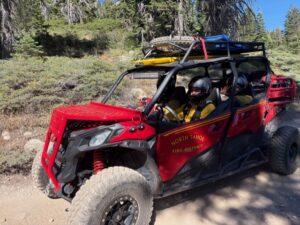
North Tahoe Fire District vehicle arriving on scene from the Rubicon Trail.
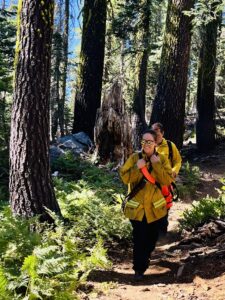
North Tahoe Fire crew arriving on scene.
Holding the Line
Perhaps the hardest part of the response wasn’t medical; it was managing the different opinions. Well-meaning members in the group wanted to lift the dressing to apply antibiotic ointment, but removing the dressing, even briefly, risked undoing the pressure that was already working to stop the bleeding.
“I had to be firm and confident,” Nicole said. “I told them I’d just taken my WFA course in October, and I knew exactly what to do: apply pressure, leave it alone, don’t peek. If you need more coverage, add another layer on top of what’s already there.” It was a small moment, but it mattered: holding her ground and keeping the original dressing intact instead of letting it be disturbed turned out to be exactly the right call.
Tim, watching from the ground, remembers the calm in her voice more than the exact words. “Nobody panicked,” he said. “That reassurance made a huge difference.”
It didn’t hurt that Tim brought his own perspective to the moment. Decades earlier, he’d worked as an EMT and later spent 25 years as a reserve police officer. “I couldn’t help sizing up what everyone was doing,” he said. “But what I kept coming back to was that everything was being handled, so I just let them handle it.”
The Wait and the Walk Out
A California Highway Patrol helicopter circled overhead about ninety minutes after the SOS alert, confirming the group’s location to the rescue teams on the ground. Shortly after, a crew from North Tahoe Fire drove in along the Rubicon Trail and assessed Tim on scene.
Fully alert and cleared to move under his own power, Tim walked — with assistance — roughly a third of a mile to a waiting Ranger side-by-side, which carried him out to a ground ambulance for the trip to the hospital in Truckee.
“They Were Pleasantly Surprised”
At the hospital, the wound told the real story: a forehead laceration the ER doctors described as having essentially scalped him, plus a gash across the bridge of his nose. It took 36 stitches to close — 8 subcutaneous, 22 external on the forehead, and 6 on the nose.

Thirty-six stitches to close.
❗To see a photo of the head laceration before the stitches, check out our feature in Wilderness Medicine Magazine. Viewer discretion advised!
“[The field team] were pleasantly surprised at how well we controlled the bleeding,” Nicole said. “It was an easy handoff. They didn’t have to do much medically beyond what we’d already done.” For a group of paramedics who see plenty of improvised field dressings, that’s a real compliment, and a sign of how training, applied calmly and correctly, can change the outcome of a bad fall.
“I don’t think I could have fallen in a better spot,” Tim said. “It really felt like right place, right time.”
Be Ready Before It Happens
Both Nicole and Tim point to the same thing when asked what made the difference: training that turns into muscle memory under pressure. “It gives you an outline to follow when things go sideways,” Nicole said. “It just takes a second to check a box in your mind: did that, did that, did that. Then you move to the next step.”
Since the incident, Nicole has restocked her first aid kit with better compression wrap and encourages coworkers and fellow hikers to take a Wilderness First Aid course — not just for the medical skills, but for the confidence to lead when others aren’t sure what to do.
When you’re ready to gain those same life-saving skills, check out our upcoming Wilderness First Aid course schedule to stay prepared for your next backcountry adventure.